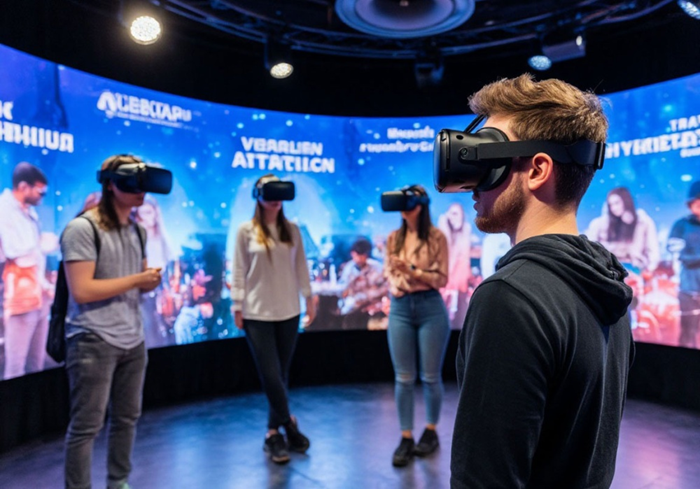
Business virtual reality entertainment opens up new opportunities for companies across various industries. Virtual reality technologies enable the creation of unique training programs, conduct marketing events, and optimize product design and development processes.
Using VR helps increase operational efficiency, improve customer engagement, and reduce costs, making businesses more innovative and competitive.


VR Technologies in the Transformation of Corporate Training Programs
The use of virtual reality in training allows for the creation of immersive and interactive environments in which employees can practice skills in conditions as close to reality as possible. This technological integration significantly improves training effectiveness through deeper information comprehension and reduced time spent mastering new procedures.
The introduction of VR into corporate training programs also helps reduce the costs of training and competency development. The ability to simulate complex situations and emergencies without risk to employees or equipment makes training safer and more controlled, and also expands the geographic reach of training through remote access to virtual classrooms.
Advantages and Features of VR Training
Advantages of VR in Training:
- Increased employee motivation and engagement;
- Practical skill reinforcement in a safe environment;
- Individualization of training programs;
- Scalability and reusability of content.
Characteristics of implementing VR technologies include the need to develop specialized scenarios and virtual simulators, as well as taking into account technical requirements and ensuring access for all program participants.
Innovative Training Methods Using Virtual Reality
Virtual reality (VR) is becoming an increasingly popular tool for developing corporate skills and Improving the effectiveness of employee training. Using VR technology allows for the simulation of real-life situations, which facilitates deeper knowledge acquisition and the development of practical skills. This approach is characterized by high participant engagement and the ability to repeat training sessions without additional resource expenditure.
Modern VR training methods are based on interactivity and personalization. They allow for the creation of unique scenarios tailored to specific company objectives, increasing their relevance and effectiveness. VR training allows employees to experience challenging situations in a safe environment, which helps reduce errors and build confidence.
Benefits of Using Virtual Reality in Training
- High Engagement: VR creates an immersive environment that encourages active participation and motivation.
- Safety: Ability to practice in dangerous or challenging situations without risk to health.
- Personalization of training: Scenarios can be adapted to the knowledge level and role of each employee.
- Cost-Efficiency: Reduces costs for physical materials and training space.
- Instant Feedback: VR systems allow for analysis of actions and error correction in real time.
Key Areas for Implementing VR in Training Practice
- Customer Service Skills Training and Sales.
- Development of management competencies and teamwork.
- Crisis simulation and stress management.
- Training on equipment and technical support.
- Improving safety and preventing occupational injuries.
Conclusion: Prospects for Using Virtual Simulations in Business
The implementation of VR technologies contributes to the creation of more efficient and safer working conditions, which in turn leads to cost reduction and increased competitiveness of enterprises. The development of virtual simulations promises significant changes in the organization of production, making processes more technologically advanced, adaptive, and safe.
The use of virtual simulations in business is a promising area that helps optimize production operations and improve worker safety. Investment in these technologies is justified as they help reduce costs, increase efficiency, and create a safer working environment. In the future, VR capabilities are expected to expand to address increasingly complex challenges in industrial and risk management.